By D. Medina
There are mornings that exist only in dreams — where the air feels softer, the light falls just right, and time seems to slow its breath. It’s in those rare moments, untouched by urgency, that serenity takes form. Sometimes we live them. Other times, we find them captured in art.
Main Article
As I flipped through the pages of my favorite art magazine, Arts to Hearts Magazine (link here), one piece instantly caught my eye.
Let me start by saying — this magazine is my all-time favorite for exploring art. It’s a global community with a focus on contemporary and emerging women artists around the world. Which, of course, I love.
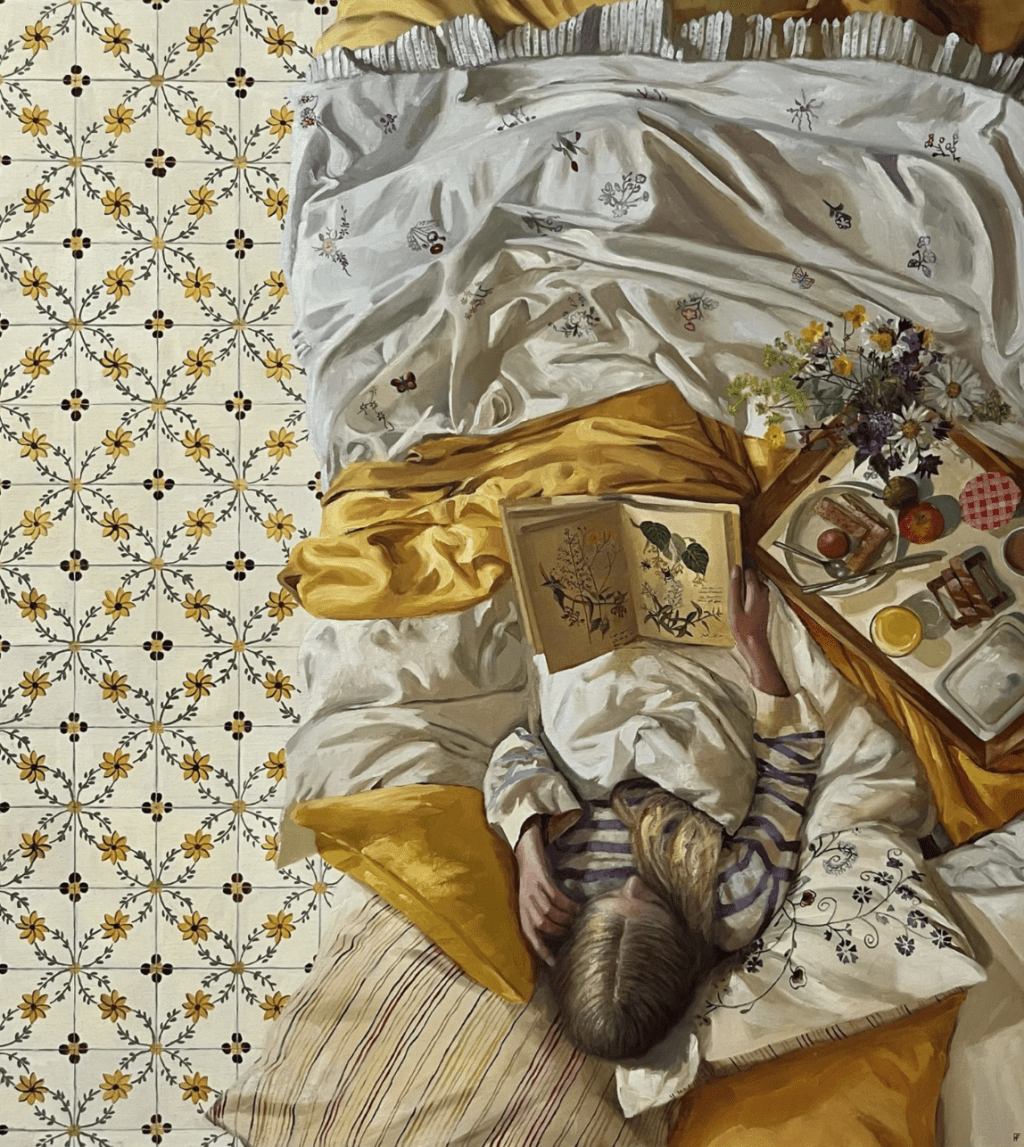
The piece I’m talking about is by their Issue #9 cover artist, Frances Featherstone, from her collection From the Perspective of the Angels.
Her art is simply stunning. It speaks in a way that feels rare — a unique perspective that not many capture. The name of this piece says it all: Serenity.
When I see it, I feel a wave of something I haven’t experienced in a long time. It’s the quiet beauty of a day completely to yourself — self-care, reading, perhaps flipping through your favorite magazine. A pause from everything and anything. A moment longed for, and here, perfectly preserved on canvas.
The Art of Quiet Observation
The composition of Serenity is masterful. Seen from above, the perspective invites you into a private moment — as if you’re an unseen presence floating above, witnessing a slice of someone’s quiet morning. The floral patterned floor, the crisp white linens scattered with embroidery, the vibrant yellow blanket — every detail whispers warmth.
What strikes me most is the intimacy. There’s no direct eye contact, no performance for the viewer. Instead, you’re observing a genuine, unposed ritual: a woman immersed in a book of botanical illustrations, a breakfast tray waiting nearby, fresh flowers echoing the patterns in the pages she holds. It’s a still life, yet it breathes.
Frances Featherstone’s work often plays with this kind of elevated viewpoint — hence the collection’s title, From the Perspective of the Angels. It’s a vantage point that feels both protective and reverent, as though the subject’s peace is something sacred. In Serenity, this translates into a visual lullaby, softening the edges of the world for just a moment.
It reminds me that art is not always about grand statements or dramatic subjects. Sometimes, it’s about catching the poetry in everyday life. About holding still long enough to see beauty in a plate of breakfast fruit, the folds of a blanket, the sunlight that creeps across patterned tiles.
Serenity as Self-Care
In our fast-paced, hyper-connected world, moments like the one in Serenity feel almost mythical. We scroll, we rush, we fill our days with noise, rarely allowing ourselves the space to simply be. Featherstone’s painting reminds us that self-care doesn’t always require grand gestures or elaborate plans — sometimes, it’s as simple as giving ourselves permission to linger.
Art like this serves as both mirror and invitation. A mirror, because it reflects back to us the longing we often carry: the yearning for rest, for beauty, for unhurried mornings. An invitation, because it whispers, You can have this too. Not in some distant, imagined life — but here, in your own space, on your own terms.
That’s the power of work like Frances Featherstone’s. It isn’t just about technique or composition (though both are impeccable); it’s about what lingers after you’ve turned the page or walked away from the gallery wall. It’s about the reminder that serenity is not something we must chase, but something we can choose — if only we make room for it.
So maybe the lesson Serenity leaves us with is this: slow down. Let beauty find you. And when it does, allow yourself to stay in that moment just a little longer.
Disclaimer:
This reflection is my personal interpretation and is written for artistic commentary purposes only. All rights to the artwork Serenity belong to the artist, Frances Featherstone. Images and links are shared solely for appreciation and review. Please credit the author and link back to this post if you share any portion of this article.
 IN IVY & INK
Leave a comment